
Global Corridor #7
New book on the Belt and Road Initiative, Burkina's revolutionary road, Destiny, a new special economic zone in the Caribbean, Foster design transport hub in Poland, Venezuelan oil, Pakistani railways

Dear Readers - welcome to the Global Corridor newsletter. The world is experiencing massive restructuring of its economy, territory and technologies through new global infrastructure projects. Many of the investments in new railways, data-centres, real estate developments, port expansions, special/extractive zones, highways, and more are proceeding through transnational, multi-modal corridors. We are seeing the making of a new global geography at an unprecedented pace and scale. I’ll be providing a round up of some of the most interesting news, stories, data, opinion + academic work that can help us make better sense of this transforming world, including news from my own project.
1. Global Infrastructure News Briefing:
Building the infrastructure of the Burkina revolution
In December I was lucky enough to meet a delegation from the front line of a quiet revolution happening in Burkina Faso. And since then news has emerged of construction of its first major highway, marking a significant step in the country’s efforts to modernise its transportation infrastructure. The project officially commenced in mid-December 2025 with a ceremony near Ouagadougou, where President, Captain Ibrahim Traoré initiated the works on the Ouagadougou–Bobo Dioulasso Expressway, a 332-kilometre, four-lane highway linking the political capital with the country’s principal economic hub in the southwest. The road will include major engineering features like interchanges and grade-separated crossings to enhance safety and travel efficiency. Officials believe the highway will reduce travel time significantly, lower transport costs, and improve the reliability of logistics flows across the country’s central corridor. The project is part of a wider vision to upgrade the national road network, with plans to extend expressway standards to other regional capitals, improve key trade links, and reinforce Burkina Faso’s role in West Africa’s transportation system.
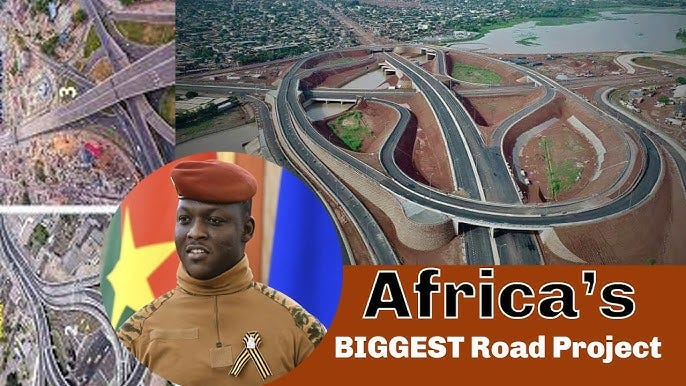
This expressway is being developed under the government’s Faso Mêbo initiative. This is a presidential initiative, adopted in October 2024 by Traoré. Meaning "Build the Country" in Mòoré and Dioula, it is a national solidarity project designed to improve urban living, reduce dependence on foreign aid, and foster development through civic engagement. Notably, unlike many large projects in the region, funding is being drawn primarily from state resources, with around CFA 200 billion (approximately $357 million) allocated in the 2026 national budget to cover construction costs. It is also being built using local resources and volunteer labor. This directly aligns with the revolutionary principles set out by the assassinated 1980’s leader of the country Thomas Sankara, of self-reliance, showing how his legacy lives on. It might even show a new way to build large scale infrastructure in Africa.
Destiny? Turning a Caribbean island into a Special Economic Zone
News emerged internationally in December of Bitcoin investor, Olivier Janssens plans to transform part of the small Caribbean island of Nevis (population 13,000) into a off-shore, special economic zone. You can watch the (in many ways creepy) promotion film below. Janssens is making all sorts of promises of jobs, economic development and sustainability that would be expected. Janssen, a Belgian that has bought St Kitts and Nevis citizenship and therefore allowed to purchase land is an interesting figure that claims to be a “lifelong libertarian”. Meanwhile, his company South Nevis Ltd is working with Sharon Brantley, who is married to Nevis' premier, Mark Brantley to buy up large tranches of land in the south of the island.
Reception from Nevisian’s has been mixed with some welcoming the economic opportunities being promised, while others are furious about the separate legal, financial and other systems and regulations, that are being implemented as part of the scheme, as well as the large scale land ownership that is being accrued by Janssens. The newspaper of the island (and its twin St Kitts) has been running adverts from Destiny for a few months now but seems to have some good coverage for those wanting to find out more, amid the relentless positivity toward the project.
Destiny, mirrors crypto-libertarian schemes such as Próspera in Honduras being promoted by wealthy figures in big tech that have run into serious troubles with the national government ‘hosting’ these attempts at building new types of urban futures.
Poland announces new Foster and Partner’s $34BN transport mega-hub
Poland has formally advanced plans for a vast $34 billion transport mega-hub, a centerpiece of its long-term infrastructure strategy that aims to transform the country into a key European connectivity node. The project, officially known as Centralny Port Komunikacyjny (CPK) and recently rebranded as Port Polska, will combine an entirely new mega-airport with an integrated high-speed rail and road network west of Warsaw. Intended to open around 2032, the hub is designed to serve tens of millions of passengers annually and eventually rival major Western European airports in scale and connectivity.
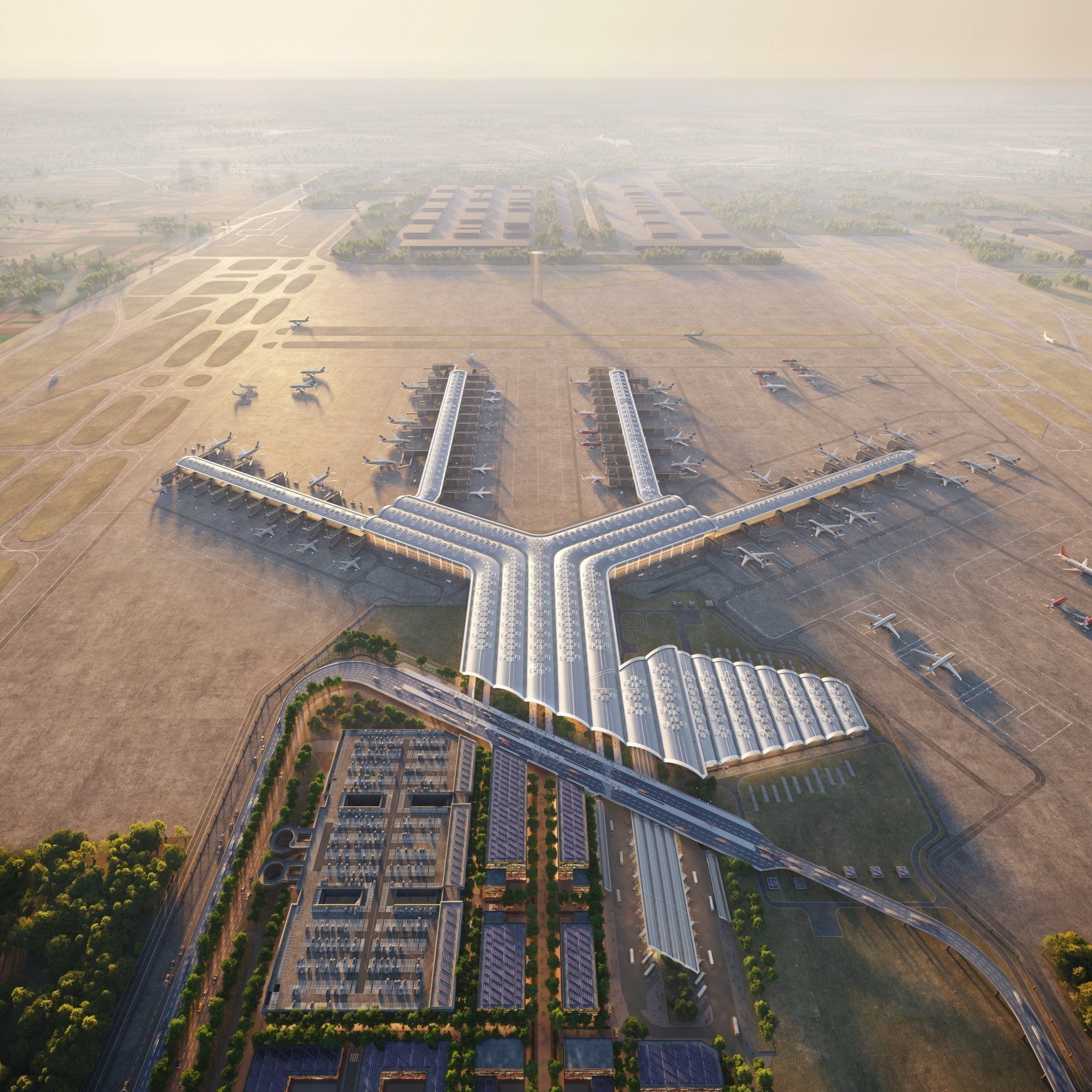
British architecture firm Foster + Partners, alongside engineering partner Buro Happold, were selected as master planners for the hub’s terminals and transport interchange, designing what they call a “21st century transport interchange that brings together air, rail and road, while reflecting the country’s national identity and providing exceptional passenger experience.” The airport will be part of a nationwide high-speed rail network linking major Polish cities and, ultimately, international destinations . drastically cutting travel times and boosting domestic mobility.
Polish Prime Minister Donald Tusk described the development as symbolic of Poland’s growing role in Europe, naming the complex “Port Polska” and positioning it as a future global gateway. It certainly offers an infrastructural embodiment of Poland’s increasing economic and diplomatic weight in Europe.
SoftBank to acquire DigitalBridge for $4bn
SoftBank Group has agreed to acquire DigitalBridge Group for approximately $4 billion, marking a decisive pivot by Masayoshi Son from AI software to the critical physical infrastructure required to power it (a move being made by many AI and software companies these days). Under the terms of the all-cash deal, SoftBank will pay $16.00 per share, representing a 15% premium over DigitalBridge’s recent closing price. The acquisition is expected to close in the second half of 2026, subject to regulatory approvals.
The deal aligns with SoftBank’s mission to realize “Artificial Super Intelligence” (ASI). As AI models grow in complexity, the bottleneck has shifted from code to commodities—specifically power, data centers, and connectivity. By acquiring DigitalBridge, which manages over $108 billion in digital assets (including stakes in Vantage Data Centers and Switch), SoftBank secures direct access to the “backbone” of the AI economy. DigitalBridge will continue to operate as a separately managed platform. Marc Ganzi, who successfully transitioned the firm from legacy real estate to digital infrastructure, will remain CEO. For SoftBank, this transaction demonstrates its intentions move it from a passive investor into an active operator of the essential utilities underpinning the next generation of global computers.
Venezuela’s oil infrastructures
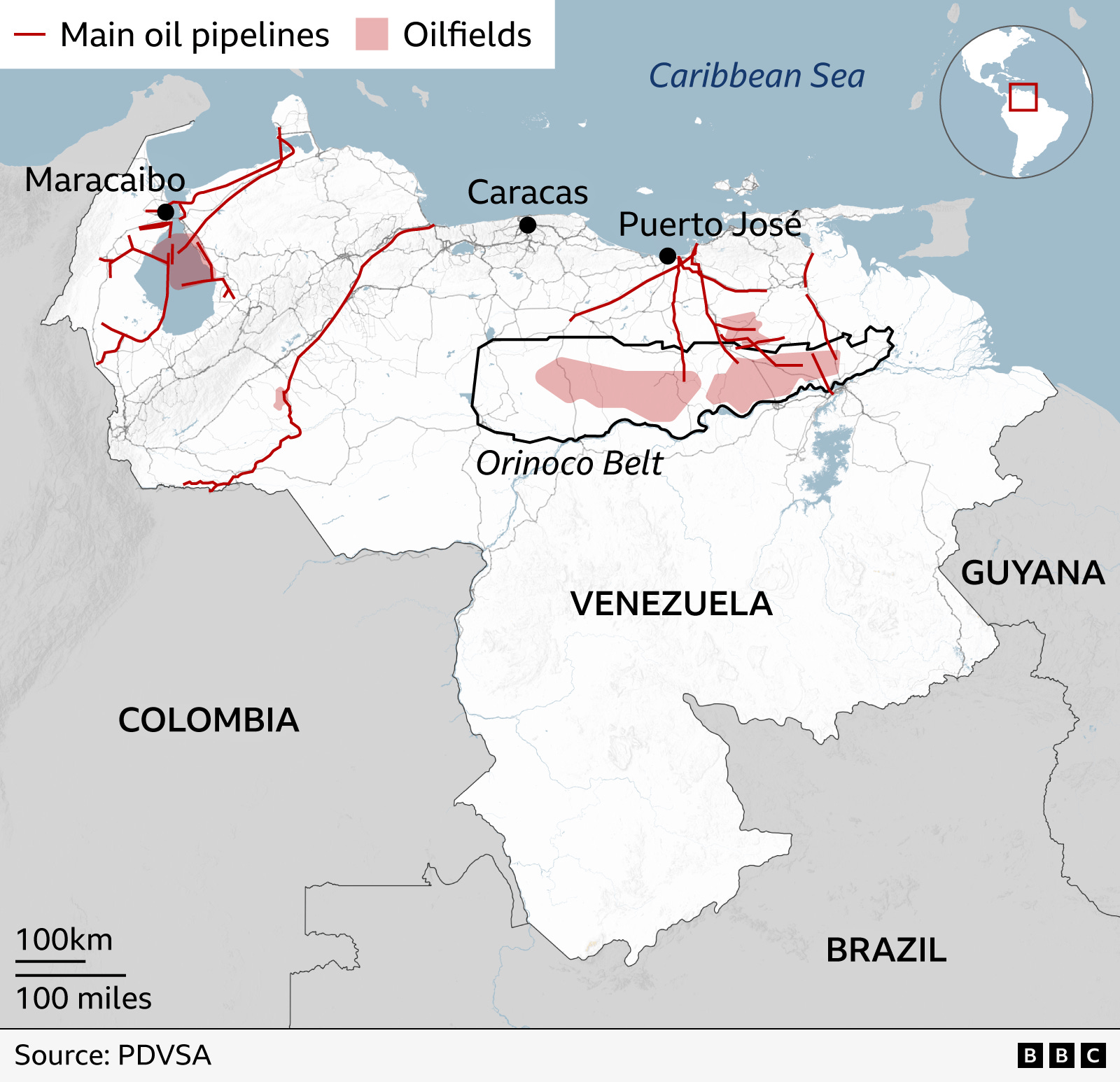
There’s been some good writing on the state of Venezuela’s oil infrastructure since the attack by the United States, including some useful maps such as the one below from the BBC. Adam Hanieh writes about how the long term decay of this infrastructure due to, “Years of US sanctions, compounded by PDVSA’s internal deterioration” has meant “its state-owned company, Petróleos de Venezuela S.A. (PDVSA), has been systematically stripped of its downstream capacities”. It is these longer (pre-Trump) histories which mean the conditions for reviving the petro-economy remain challenging even for US companies that are getting ready to ride the wave of imperialism into the country on favourable terms. I also found useful further expanded perspectives that can be found beyond the focus on extractive economic logics toward an understanding that “demands analysis grasping the intersection of strategic competition, financial leverage, and institutional collapse, not simply equations of blood and barrels.”
2. Featured Image: Konza Technopolis
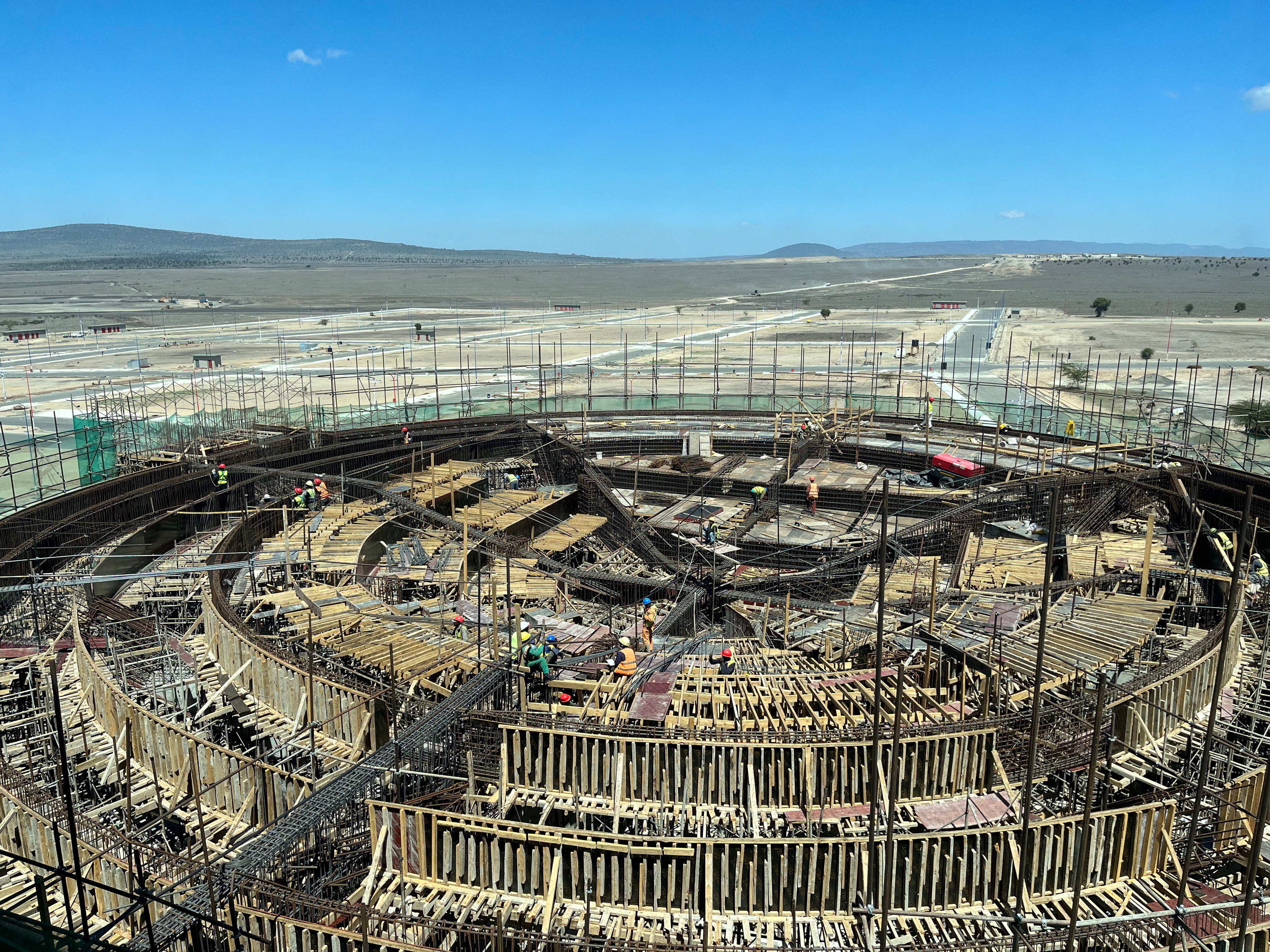
Image showing construction underway on the Konza Technopolis conference centre in 2023. The KTC has long been planned as a new city south of Nairobi, led by the Kenyan Government and envisaged as a techno-hub for the future economy. While there has been little on the ground construction, leading to suggestions the project has become a ‘white elephant’ the Kenyan state continues to invest in the infrastructure of this new city and progress, however slow continues (Image J Silver).
3. Global Infrastructure on Film: Tarakiyati Kaam Jari Hai - Developmental Work in Progress
You can now watch ‘Tarakiyati Kaam Jari Hai - Developmental Work in Progress’ - a film directed by Zainab Farid, developed in association with the Karachi Urban Lab and our Global Corridor project at the Urban Institute,
“Plans for developing the ML-1 Train line project remain uncertain. Shabnam, who built her home three years ago, and Ayesha, whose third generation now lives by the railway track, share their experiences. They talk about the troubles, uncertainty, and stress that come along with living by rail. Mehboob Illahi and Abdul Ghaffar's ongoing efforts to mobilize and create awareness among the affectees continue through the formation of the ML-1 Mutasereen Action Committee.”
4. New Academic Papers on Global Infrastructure
Featuring a selection of new academic papers covering various types of scholarship on global infrastructure:
AI Empire: The Rise of Technocolonialism by Mohammad Mohi Uddin in The Journal of Imperial and Commonwealth History
The rapid flourishing of Artificial Intelligence (AI) has sparked multiplex debates across the world, revealing not only its transformative potential but also its capacity to reproduce deep global inequalities. This commentary article argues that contemporary Artificial Intelligence (AI) development reflects a renewed form of colonial domination – technocolonialism – rooted not in race or territorial conquest but in unequal control over data, infrastructure, and technological governance. Drawing on the colonial matrix of power, the analysis shows how AI systems extract global knowledge without consent, reproduce epistemic hierarchies, and rely on an international division of digital labour that disproportionately exploits the Global South. It further exposes the ethical opacity of AI corporations whose black-box practices reinforce global asymmetries while demanding accountability only from users. The commentary calls for proactive decolonisation, equitable governance, and coordinated global action – particularly through the United Nations – to prevent AI from deepening historical patterns of dependency. It concludes that unless redirected toward justice, AI risks becoming the next empire, reshaping global inequalities in digital form.
Zone, city, border, corridor: recombined territoriality, infrastructural coupling, and geoeconomic regionalization across the China‐Laos nexus and beyond by Chen Xiangming in Singapore Journal of Tropical Geography
Through its growing impact on different scales, China’s Belt and Road Initiative (BRI) has shaped the recombination of such territorial elements as cities and borders, with transformative consequences for place-making and regional development. This impact has become especially visible across a number of hitherto relatively peripheral and largely unconnected localities and livelihoods that have received connective projects via infrastructural coupling, with locally embedded and regionally connective impacts. To investigate these related issues, this paper examines how zone, city, border and corridor have been recombined via the BRI’s infrastructure-enabled geoeconomic regionalization across the China-Laos borderlands. This analysis sheds much light on new interconnections among rail-enabled geoeconomic regionalization, asymmetrical cross-border flows, special zonal development, incipient city-making and infrastructure-induced change in local lives, especially in northern Laos.
Mapping signal territory: Undersea cable disruptions, affective nationalism and turbulent ecologies by Chi-Mao Wang in Environment and Planning D
This paper introduces the concept of ‘signal territory’ to explore how telecommunication infrastructures, particularly undersea cables, are reshaping the geopolitics of sovereignty, affect and digital connectivity. Focusing on Taiwan’s Matsu Islands, a geopolitically sensitive frontier near China, the study examines how signal disruptions caused by cable damage produce affective responses and reconfigure notions of national security and belonging. Drawing on interviews, media analysis and official documents, the paper traces how affective nationalism and anticipatory governance converge in state-led efforts to re-territorialise invisible signal transmissions across land, sea, air and outer space. These efforts include satellite back-ups, microwave systems and legal proposals to protect undersea infrastructure. However, they are continually challenged by turbulent ecologies – ranging from oceanic forces and geomorphology to the geopolitical complexities of submarine cable governance. The paper situates these dynamics within broader literatures on volumetric politics, infrastructure studies and digital sovereignty, arguing that the territorialisation of signals marks a shift in how sovereignty is exercised in the digital age. By conceptualising signal territory as a socio-technical and affective assemblage, this study offers a new framework for understanding how states confront infrastructural vulnerabilities in contested geopolitical environments.
Reshaping Global Supply Chain Fragmentation: The Geopolitics–Digitalization-Sustainability Nexus İn Ethiopia by Chekole Sete Demeke in Journal of International Trade, Logistics and Law
This study critically explores how the interdependent forces of geopolitical uncertainty, digital fragmentation, and climate vulnerability, termed the “triple nexus, “ reshape Ethiopia’s role within increasingly fragmented global supply chains. As a landlocked economy at the crossroads of major regional initiatives such as the Belt and Road Initiative (BRI), the African Continental Free Trade Area (AfCFTA), and the African Growth and Opportunity Act (AGOA), Ethiopia presents a unique case of both strategic potential and structural fragility. Utilizing a systematic literature review guided by PRISMA protocols, the research synthesizes multidisciplinary evidence to assess how escalating regional conflicts, trade policy volatility, and overdependence on the Djibouti corridor expose Ethiopia’s logistics networks to chronic disruptions. Concurrently, pervasive digital divides limit the adoption of traceability and automation technologies, while reliance on foreign infrastructure raises data sovereignty concerns. Sustainability pressures, including climate-related export shocks and weak labor governance, further challenge the country’s competitiveness under evolving Environmental, Social, and Governance (ESG) standards. In response, the study proposes an integrated institutional resilience framework anchored in geo-economics, digital inclusion, and sustainability law. It identifies actionable strategies such as corridor diversification, rural digitalization, and green industrial policy. The findings underscore that for Ethiopia, and similarly positioned economies, addressing the triple nexus is no longer optional but essential to achieving resilient, inclusive, and future-ready supply chain integration.
Project News: New Open Access edited book ‘The Material Geographies of the Belt and Road Initiative’
With fellow editors, Elia Apostolopoulou, Han Cheng + Alan Wiig and alongside an amazing group of contributors we are pleased to see our Bristol University Press book is now published. “The Material Geographies of the Belt and Road Initiative: Infrastructures and Political Ecologies on the New Silk Road’
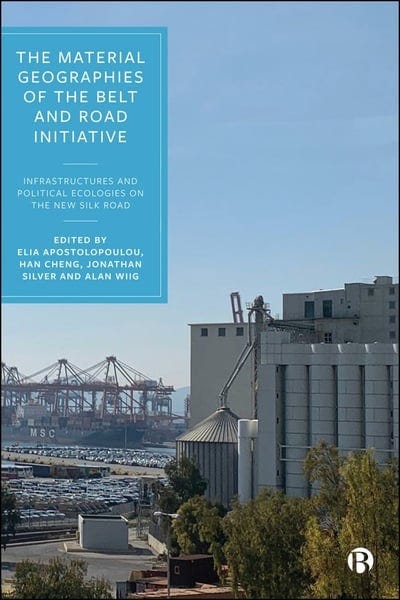
China’s Belt and Road Initiative (BRI), commonly called the New Silk Road, is a huge infrastructure project currently revitalising or creating new trading routes and large developments across the globe. It is estimated to cost up to US$8 trillion and impact more than 65% of the world’s population.
This book explores the unequal ways this controversial project is altering livelihoods, places and the environment. From road building projects in Nairobi to grassroots environmental activism in Thailand, researchers from the Global North and South analyse the real-world impacts of this unprecedented project, bringing together critical geography and political ecology approaches.
And best of all it is Open Access and available to download and read for free here
The framing of corridors as not just infrastructure but as reshaping global geography is spot on. Its fascinating how these multi-modal projects create entirely new economic realities rather than just connecting existing ones. The fact that this BRI book is Open Access makes such critical analysis much more accessible to scholars outside traditional institutional access. Really appreciate these roundups bringing together academic work and on-the-ground developements!